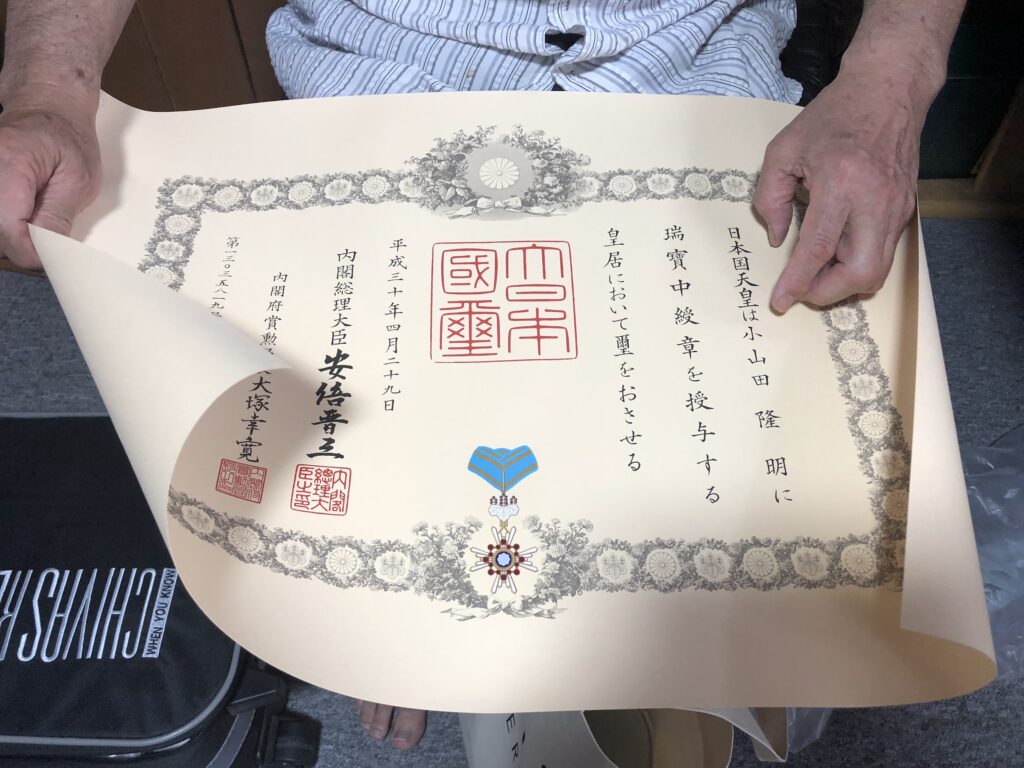
I grew up between New York and the rural countryside of central Japan, near Nagoya, where I would spend the long summers immersed in nature, away from the monotony of suburban life. With my extended family, including grandparents, parents, two siblings, cousins, aunts and uncles, we would play suika-wari and fix the shoji the cats would destroy under the rich scent of pyrethrum wafting off the dark green mosquito coils. My grandfather was a psychologist, for over 40 years in fact, in Gifu. At home, he would encourage me to think deeply and freely, which in part led me to find an early passion in science and medicine.
He would tell me about his days as a visiting scholar in the ’80s, where he lived in Madison, Wisconsin with his family for several years. As a Japanese scientist, being a visiting scholar in America was a distinguishing badge of honor, much like the great Hideyo Noguchi (syphilis) or Akira Endo (statins) before him. As a Japanese scientist, traveling to America for research was an opportunity to become a household name. A living example today being Shinya Yamanaka, Nobel laureate credited with pluripotent cell reprogramming and the “Yamanaka factors.”
To many of us, there’s a certain kind of excellence that’s associated with being in America as a Japanese scientist. Hideyo Noguchi has been prominently placed on the 1,000 yen bill for many years, unlike most countries who place monarchs and politicians. Noguchi’s story of scientific prestige despite his lifelong disability is still proudly taught in many Japanese classrooms today, placing him as one of the key examples of national scientific excellence. Paradoxically, this dream of scientific excellence in America is taught often alongside the trauma of Nagasaki and Hiroshima as early as primary school.
Though Japan has a complex history with America, this feeling of pride and prestige as a Japanese scientist in America is still hard to deny. Studying in America remains a badge of honour for many Japanese nationals and especially scientists educated in Japan. But this wasn’t something I understood intrinsically. Though I spent 3-4mo in Japan every year, I was after all educated in American public schools, in American universities, and American companies, until I moved away last year.
Now, examining America from afar, it’s abundantly clear that America is indeed the promised land for anyone in science and innovation. I know this has long been the case for many Asian nationals, not just Japanese. But this status feels once again like it’s about to shift.
Today, it feels more and more that the centre of gravity for scientific talent is shifting away from America. In large part, this is a net-positive thing for the world as countries’ innovation ecosystems become increasingly independent. The re-ignition of sovereign Japanese building spirit is nice to see, at least from where I stand. And with the global AI race today the sovereign spirit has never felt stronger.
But where science innovation’s centre of gravity will shift in the future is a big question of mine. America may hold the dream for many, or they may not. But when I think about my grandfather’s story — a psychologist from Gifu who treated his years in Madison as the defining chapter of his career — I see how significant the dream of America meant to him. I can’t help but transpose my story on top of mine and my friends who travel far away for the sake of their career. Today, America is no longer the only place that promises that kind of opportunity. Probably not for you reading this, either.
So, where’s your America? are you sure it’s America?